
Comines, or the art of being everywhere at once
On the Franco-Belgian border, where the Nord region meets Flanders, Comines occupies a position that is rarely noticed on a map – and that you never forget once you've understood it. A few minutes from Lille, on the banks of the Lys river which forms the border here, the municipality sits at the exact centre of one of the most densely populated and dynamic population centres in North-Western Europe.
At the heart of a living basin of 2.2 million inhabitants
Lille is often spoken of as an isolated metropolis. This overlooks the fact that it lies at the centre of a true cross-border conurbation, and that Comines occupies one of its points of equilibrium. The municipality belongs to the Lille-Kortrijk-Tournai Eurometropolis, a living area shared between France and Belgium which, according to its official profile, brings together 2.2 million inhabitants spread across 155 municipalities – half French, half Belgian, straddling Flanders and Wallonia.
This space is anything but an administrative abstraction: there are over a million jobs, universities, decision-making centres, and one of the most concentrated business networks in France. Broadening the scope to a radius of about a hundred kilometres, over three million consumers, talents and potential partners become accessible. Few municipalities of this size can say the same. Comines is not on the periphery of a large market: it is one of its hinges.
A border that is no longer a limit, but an asset
What could have remained a constraint has become, here, a decisive advantage. The position of Comines provides access, in a single move, to both the French and Belgian markets. A company that settles there does not choose one country over another: it benefits from both.
This first applies to recruitment. The cross-border employment pool allows us to tap into two reservoirs of skills, two work cultures, and two labour markets. This also applies to business: the region's economic culture is inherently international. French and Dutch are spoken here, and trade has taken place on both sides of the border for generations. People live, work, and receive healthcare here without the border ever being a barrier – offering companies the assurance of operating in a profoundly international environment, where the codes of neighbouring markets, including the UK, are intuitively understood.
Everything, or almost everything, at half past
Comines« accessibility is due to its location at one of the busiest road junctions in North-Western Europe. The territory lies at the intersection of major motorway corridors connecting the Dutch conurbation (Amsterdam-Rotterdam) to Paris and London, and the Ruhr. The A1, E17 and E42 form a veritable »Y" here at the gates of the Lille conurbation, with border crossing points at Rekkem and Camphin-Lamain.
In practice, the essentials are brought together in a timeframe that few locations can offer. Lille is only about twenty minutes away; Kortrijk and Mouscron about fifteen minutes; Tournai twenty-five minutes. Ghent and Bruges are three-quarters of an hour away, Brussels a little over an hour, and even Paris is accessible within a day, at around two and a half hours. In other words, you work in Comines as if you were in the centre, without suffering the usual constraints.
At the heart of the major European flows
In addition to this road accessibility, there is connectivity on another scale. Lille Flandres and Lille Europe train stations, which are very close by, welcome over 25 million travellers per year and place the region on the major high-speed lines: Paris, Brussels, Amsterdam and London are no longer distant destinations, but stages within the same working day. Lille-Lesquin airport, which exceeded 2.2 million passengers before the health crisis, completes the facilities, while Brussels and Charleroi airports are just over an hour's drive away.
For production and logistics activities, an additional asset is worth highlighting: the Ports of Lille are the third largest inland port in France, and the area lies at the heart of the future largest European inland waterway network. With the commissioning, planned for 2030, of the Seine-Nord Europe canal and the Seine-Escaut link, this large-scale network will directly connect the region to major seaports and the economic heart of the continent. Few will, in the future, offer such a combination of road, rail, air, and water.
The rarity of a preserved setting
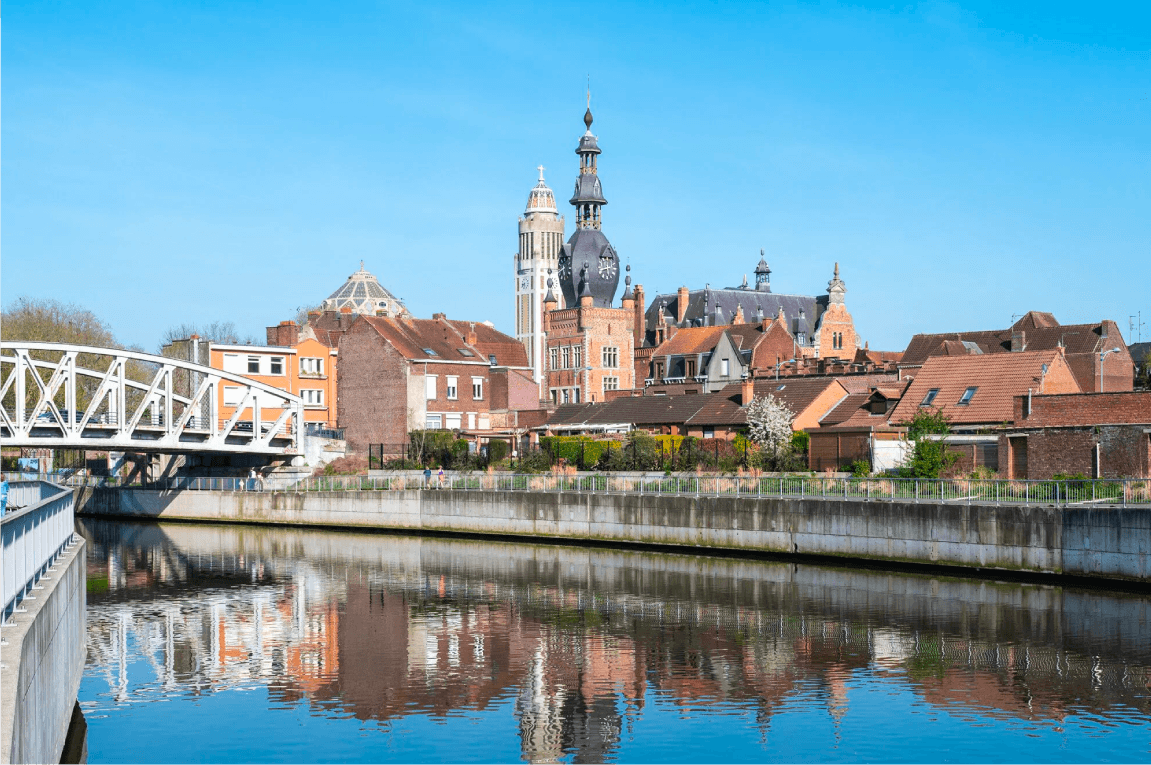
And yet – and this is the happy paradox of Comines – this centrality is not accompanied by any of the drawbacks usually associated with major hubs. The town has retained a semi-rural character, a sense of space, a quality of life that the metropolis, just a few kilometres away, can no longer offer. The setting is revealed as soon as you step out of the door. Barely a hundred and fifty metres separate the business premises from the first country lanes: here, nature begins almost at the foot of the offices. All around, walking paths open up in every direction – along the Lys, a natural border that connects nine French communes to three Belgian communes, as well as through the green spaces that encircle the town, for dozens of marked kilometres that can be covered on foot or by bicycle. This provides a real chance to take a breath close to your workplace.
It is also a territory of identity and heritage: the belfry of Comines is among the monuments listed as UNESCO World Heritage, a testament to a shared Flemish history that can be found in the giants, the carnivals and the region's way of life. For a manager, this environment means a pleasant working setting and employees more inclined to settle there.
A prime location for corporate real estate
Visibility, accessibility, ease of recruitment, immediate proximity to two national markets: few towns of this size boast so many advantages in one area. Added to this is an argument that business leaders know well – a quality-price ratio that the Lille metropolitan area, saturated and more expensive, struggles to offer today.
It is in this context that Comines is establishing itself, discreetly but surely, as one of the most strategic locations in the Hauts-de-France region for business. For those seeking modern, well-connected premises designed to last, the town now offers a combination that the future, with its major infrastructure projects, will only enhance.
Sources: Eurometropolis Lille-Kortrijk-Tournai, Portrait 2024. Indicative travel times.